

Data Center Modernization
From white space to secure fabric — we modernize the facilities your critical workloads depend on, without interrupting service.
Modernising critical facilities without pausing the business

Most enterprise data centres in the region were not built for today's power densities, east-west traffic volumes or data-residency obligations. Rather than replacing everything, QSAT modernises what is viable and rebuilds what is not, in a sequence that protects uptime while capacity and compliance improve.
Our engineers cover the full physical and logical stack: electrical and mechanical design, containment and airflow, high-density fibre and copper infrastructure, spine-leaf switching fabric, virtualisation and storage platforms, and the monitoring layer that makes the estate observable.
Every project ends with something operations teams can actually run: labelled and documented pathways, tested failover, current as-built drawings, capacity baselines and a support model with defined response times. That handover discipline is what keeps a modernised facility from drifting back into disorder within a year.
Facility design & build
Power, cooling, containment and white-space layouts engineered to tier-aligned resilience targets for new builds and retrofits alike.
Structured cabling & fabric
High-density fibre and copper infrastructure, spine-leaf network fabric and clean, fully documented pathways that scale predictably.
Migration & consolidation
Workload discovery, dependency mapping and staged migrations that consolidate legacy estates into modern, hybrid-cloud-ready platforms.
Security & compliance
Physical access control, segmentation, monitoring and documentation aligned to ISO 9001 and client-specific sovereign requirements.
Power, cooling and capacity headroom
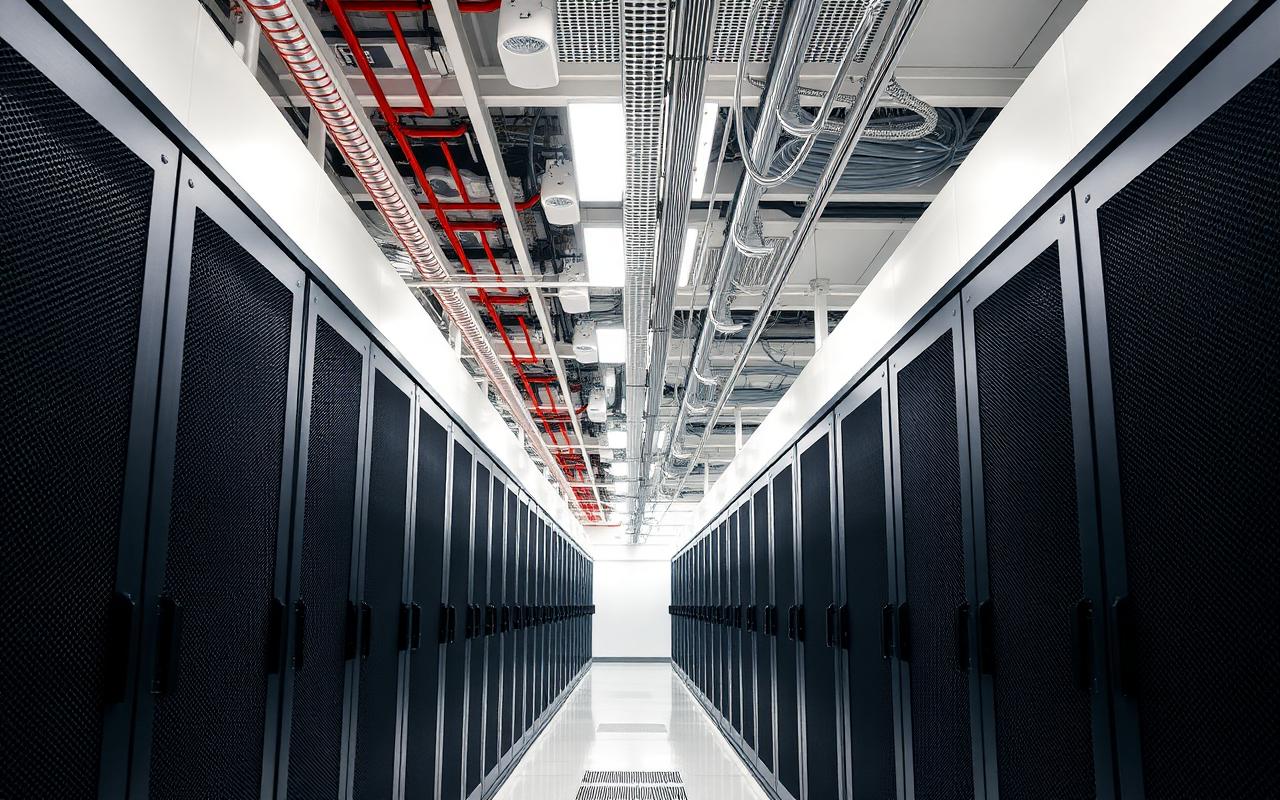
We model current and projected rack densities, then design power paths and cooling capacity with real headroom rather than theoretical maximums. Containment, blanking and airflow correction alone often recover usable capacity in halls that appear full.
Network fabric and interconnect
Spine-leaf topologies with predictable oversubscription, out-of-band management, and carrier and cloud interconnects sized for the actual traffic profile. Documented patching schemes make future changes routine instead of risky.

Migration without service loss
Discovery and dependency mapping come first, so migration waves group applications that talk to each other. Each wave has a rehearsed cutover, a validation checklist and a rollback path, executed in agreed low-impact windows.

Our teams work inside live environments — sequencing every change so uptime, capacity and compliance improve together.
Estates we modernise
Government & sovereign
In-country hosting for regulated workloads, with the access control and documentation those mandates demand.
Banking & finance
Resilient, audited environments where change control and recovery objectives are contractual, not aspirational.
Telecom operators
Core and edge facilities supporting network functions, OSS/BSS platforms and rapid capacity growth.
Large enterprise
Consolidation of scattered server rooms into standardised, monitored facilities across multiple countries.
Frequently asked questions
What does a data centre modernization project with QSAT include?
It typically spans white-space and power design, cooling and containment, high-density structured cabling, spine-leaf network fabric, workload discovery and migration, physical and logical security controls, commissioning and as-built documentation.
Can you work inside a live facility without downtime?
Yes. Most of our modernization work happens in occupied halls. We sequence changes into short, reversible windows with method statements, dependency maps and rollback plans so production workloads keep running throughout.
Do you support hybrid and sovereign cloud requirements?
We design estates that keep regulated workloads on in-country infrastructure while connecting cleanly to public cloud for elastic capacity, including private interconnects, segmentation and traffic policy aligned to data-residency rules.
What resilience standards do you build to?
Designs are aligned to tier-equivalent resilience targets agreed with the client, covering power path redundancy, cooling capacity margin, fire detection and suppression, and monitoring. Compliance documentation is aligned to ISO 9001 practices.
Do you handle small edge rooms as well as large halls?
Yes. The same engineering discipline is applied to branch comms rooms, edge cabinets at remote sites and full data halls, which matters for customers standardising dozens of locations across several countries.